GDPR, German Criminal Code & professional confidentiality: is DolmiDesk™ legally compliant?
Informationen zum Artikel

Autor: Dmitry Dugarev
For interpreters, and especially German Sign Language (DGS) interpreters, protecting sensitive client data isn't just a bureaucratic obligation under the General Data Protection Regulation (GDPR) [1] and the German Federal Data Protection Act (BDSG) [2] — it touches the very core of professional confidentiality.
If you work in a medical or legal context, you're often bound by the duty of confidentiality under § 203 StGB (German Criminal Code) [3]. A violation is a criminal offense that can be punished with a fine or imprisonment.
Skepticism toward cloud services is therefore understandable and widespread in Germany [4]. This article analyzes the facts, the technical architecture of DolmiDesk™, and the specific obligations that apply to you as a professional.
The architecture: who holds your data?
DolmiDesk™ is a classic SaaS application (Software-as-a-Service): your data lives in a database that we operate [5]. That's the honest starting point – and it's exactly why it matters where this data is stored, how it's protected, and who is legally responsible for what.


The pillars of this architecture:
- Hosting exclusively within the EU. The application, database, document storage, and dispatch of system emails run at Scaleway SAS (Paris) in data centers in France and the Netherlands [6]. No third-country transfer takes place.
- Tenant separation at the database level. Every account is separated from all others by database-level access rules – not just by application logic, but one level deeper.
- Field-level encryption. Especially sensitive fields are encrypted individually, each bound to tenant, table, record, and field. Keys are managed per tenant and can be rotated.
- Searchable despite encryption. So you can still search encrypted fields, DolmiDesk™ works with so-called blind indexes (HMAC short values) instead of plaintext search columns.
- Documents with their own keys. Generated PDFs and uploaded receipts are stored with per-file encryption in storage that isn't publicly accessible.
- Access protection. Server-side sessions, two-factor authentication, and passkeys.
Division of roles: Art. 28 GDPR
From a data protection standpoint, the division is clear [7]:
| Role | Who | For what |
|---|---|---|
| Controller (Art. 4 No. 7) | You | The content data: clients, assignments, invoices. You decide the purposes and means. |
| Processor (Art. 4 No. 8) | DolmiDesk™ | Processes this data strictly on your instructions, for the purpose of providing the application. |
| Own responsibility | DolmiDesk™ | Only for our own contractual and billing data (your account, your payment). |
Specific obligations follow from this, which we take on contractually: we do not evaluate your content data for our own purposes, we do not pass it on to third parties (other than the sub-processors named below), and we support you with data subject requests.
Sub-processors: the complete list
Art. 28(2) GDPR requires transparency about engaged sub-processors. Complete, with the legal basis for the transfer:
| Service | Provider & location | Purpose | Place of processing | Basis for transfer |
|---|---|---|---|---|
| Scaleway | Scaleway SAS, Paris (FR) [6] | Application, database, documents, system emails | France, Netherlands | No third-country transfer (EU) |
| Cloudflare | Cloudflare, Inc., San Francisco (US) [8] | Delivery (CDN), protection against attacks | Global network, connection data | DPF + Standard Contractual Clauses |
| Stripe | Stripe Payments Europe, Ltd., Dublin (IE) [9] | Payment processing (your subscription) | EEA, group headquartered in the US | DPF + Standard Contractual Clauses |
| PostHog | PostHog, Inc., San Francisco (US) [10] | Anonymous usage statistics – only with consent | EU cloud, Frankfurt am Main | Data hosted in the EU; DPF + SCC for support |
| Google Ireland/LLC [11] | Reading the calendar, calculating routes | Google infrastructure | DPF [12] |
Important context: your client data – names, assignment locations, invoice contents – lives exclusively with Scaleway in the EU. Cloudflare sees connection data (in particular IP addresses), not the content of your assignments. Stripe sees your payment data, not that of your clients. PostHog collects no content data and is completely disabled without your consent.
Google's role
Google is only involved in two clearly defined places.
1. The calendar – read-only access
When you connect it, DolmiDesk™ requests only read access to your calendar (calendar.readonly), plus your email address so you can see which account is connected [11]. Write access is never technically requested – so DolmiDesk™ can neither change nor delete your appointments.
2. Route calculation – with plaintext addresses
For distance and travel time, DolmiDesk™ queries the Google Routes API [13]. In doing so, the start and destination address are transmitted to Google in plaintext; only the distance and duration are returned.
If you use Google for calendar and email
Because your calendar lives with Google, the classic Google question is relevant here – but only for your own Google account, not for DolmiDesk™'s data storage.
| Feature | Private account (@gmail.com) | Business account (Google Workspace) |
|---|---|---|
| Cost | Free | Paid (starting at roughly €6/month) |
| Business model | Data analysis & advertising | Software license fees |
| Data protection | Google may scan some data | No ad scanning, data belongs to you [14] |
| Data processing agreement | Not available | Included & GDPR-compliant |
| Suitable for § 203 StGB | ❌ NO | ✅ YES (under conditions) |
Many data protection concerns stem from the use of private accounts, where Google grants itself broad rights to analyze data [15]. In the business context (Workspace), Google contractually guarantees that no data is scanned for advertising purposes [14].
Legal certainty: the US & third-country transfer
For a long time, a major point of criticism was data transfer to the US (known through the CJEU's "Schrems II" ruling [16]). After the Privacy Shield agreement fell away, it was unclear whether US providers could offer sufficient data protection guarantees.
For DolmiDesk™, this question is considerably defused: your content data lives with Scaleway in France and the Netherlands – no third-country transfer takes place here at all [6]. The question only remains relevant for the peripheral areas: delivery (Cloudflare), payment (Stripe), and – if you use them – calendar and routes (Google).
Current status (Data Privacy Framework)
Since July 10, 2023, the European Commission's adequacy decision has applied to the EU-US Data Privacy Framework (DPF).
- This means: the US is no longer considered an unsafe third country under data protection law, provided the US company is certified [17].
- Google LLC is certified under this framework and appears on the official list maintained by the US Department of Commerce; as of the writing of this article (2025), the certification is valid until September 13, 2026 [12].
In addition, we also base the relevant processing activities on Standard Contractual Clauses under Art. 46(2)(c) GDPR – a second legal basis, independent of the adequacy decision. Should the DPF decision fall, as happened to Privacy Shield, the legal basis wouldn't collapse without a fallback.
Your obligation: the data processing agreement with us
To satisfy Art. 28 GDPR, you need a data processing agreement (Auftragsverarbeitungsvertrag) with us [1]. You'll find it in the app under Einstellungen → Datenschutz (Settings → Privacy), together with the TOM document and the list of sub-processors.
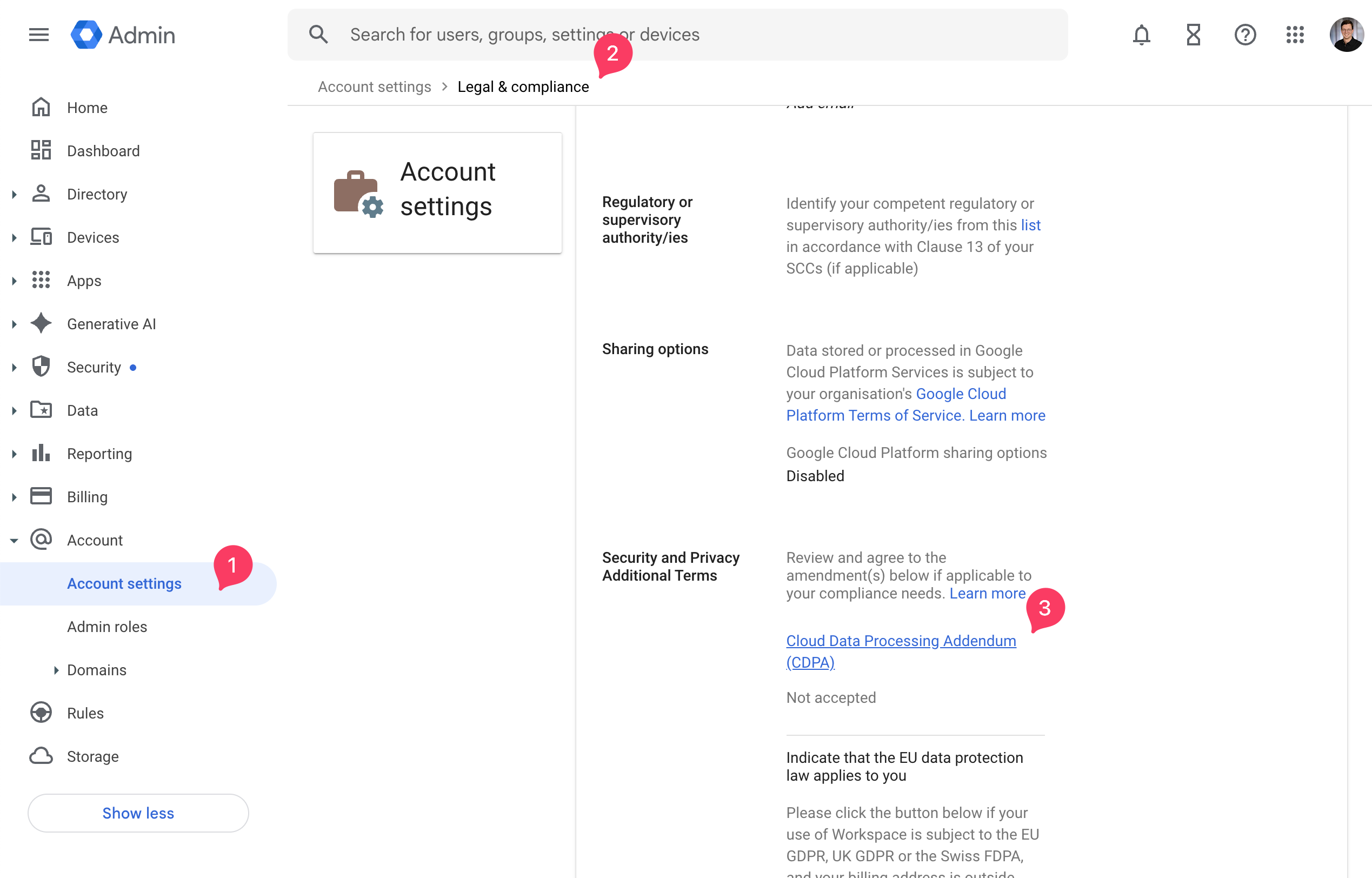
If you additionally use Google Workspace for your calendar, you'll also need the data processing agreement with Google – that's a separate contract, independent of ours.
How? In the Google Admin console under Account > Account settings > Legal and compliance. There you need to agree to the "Cloud Data Processing Addendum (CDPA)".
Shared responsibility: who protects what?
Even with a hosted application, a shared responsibility model applies – only the split shifts:
-
You are responsible for:
- the content you enter (data minimization, no unnecessary diagnoses)
- selecting and binding your service providers (see § 203 StGB below)
- your access credentials: strong login, two-factor authentication or passkeys
- who has a user account within your account
- concluding the data processing agreement
-
DolmiDesk™ is responsible for:
- operating, maintaining the availability, and securing the application
- encryption, tenant separation, and key management
- selecting and monitoring the sub-processors
- complying with the data processing agreement and supporting data subject requests
- notifying you of data breaches (Art. 33(2) GDPR)
This model means: as long as you don't record unnecessary sensitive details and secure your access, the technical protection sits with us – the content-level protection sits with you.
§ 203 StGB: are we even allowed to see your data?
This is the decisive question. When you use a hosted application, a third party is involved – there's no way around that. The good news: this exact situation is expressly regulated in the Criminal Code.
The legal situation since 2017
Until 2017, involving external IT service providers was legally tricky for professionals bound by confidentiality. With the Act on the New Regulation of the Protection of Secrets in Connection with the Involvement of Third Parties in the Professional Activities of Persons Bound by Confidentiality, §§ 203(3) and (4) StGB were introduced [18].
Since then, the following applies [3]:
- § 203(3) sentence 2 StGB: Disclosure to "other participating persons" is not an unauthorized disclosure, provided it's necessary for making use of these persons' services. IT service providers are explicitly covered.
- § 203(4) StGB: For this, you must carefully select the participating person and bind them to confidentiality. If you fail to do so, you make yourself criminally liable – not the service provider.
What we provide for this
- A commitment to professional confidentiality (Verpflichtung auf das Berufsgeheimnis) under § 203(4) StGB, covering everyone who could potentially have access on our side.
- The TOM document, as evidence for your selection decision.
- The list of sub-processors (Liste der Unterauftragsverarbeiter), so you know who else is involved – because sub-processors, too, must be bound accordingly under § 203(4) sentence 2 StGB.
You'll find all three in the app under Einstellungen → Datenschutz (Settings → Privacy).
Professional confidentiality, GDPR & sending invoices by email
This is where it gets specific for interpreters. You often process data under Art. 9 GDPR (health data, e.g. "interpreting during an oncology consultation"). But here, too, two worlds collide: strict confidentiality and the digital reality of the funding bodies (Kostenträger).
Am I allowed to send invoices by email?
In principle, an unencrypted email is as open as a postcard. The law and professional codes of conduct prohibit sending sensitive data unencrypted. But: issuing an invoice is necessary to fulfil your assignment – and the funding bodies (Kostenträger, e.g. health insurers, courts) expect to receive an invoice by email.
In principle, an unencrypted email is considered insecure (the "postcard principle"). However, exceptions apply to invoicing, based on necessity.
The legal basis for sending
You're allowed to transmit the data because there's no payment without transmission. The GDPR explicitly permits this:
- Performance of a contract (Art. 6(1)(b) GDPR [1]): issuing the invoice is an essential part of your contract with the funding body (Kostenträger). Without transmitting the invoice, the contract cannot be fully performed.
- Establishing legal claims (Art. 9(2)(f) GDPR [1]): even with sensitive health data, processing (and transmission) is permitted where it's "necessary for the establishment, exercise or defence of legal claims" (here: your claim to payment).
- Administration of the social security system (Art. 9(2)(h) GDPR [1]): if you bill health insurers or social welfare bodies, this falls under the administration of health services.
Accordingly, sending invoices by email is legally permissible, provided appropriate security measures under Art. 32 GDPR are taken.
Technical security (TLS vs. end-to-end)
Germany's data protection supervisory authorities (DSK) ideally call for end-to-end encryption (PGP/S/MIME), but acknowledge that this is often missing in business correspondence [19].
Accordingly, transport encryption (TLS) is considered an acceptable minimum standard for normal correspondence, provided no highly sensitive medical details (e.g. detailed psychological reports) are transmitted in plaintext [20].
At DolmiDesk™, sending happens via Scaleway's transactional email infrastructure in the EU [6] – not via your Gmail inbox. The transmission is TLS-secured; if the recipient authority (e.g. AOK, a court) also supports TLS – which is the norm today – the email is transmitted encrypted on its way across the internet [19].
So you remain responsible for content-level data minimization, and we remain responsible for the technical security of the sending infrastructure.
Why TLS is sufficient in many cases
Art. 32 GDPR doesn't require perfect security measures, only appropriate ones. Appropriateness depends on the risk. For simple administrative data such as invoices, the risk is low if:
- no diagnoses are included
- the recipient authority supports TLS
- you secure your DolmiDesk™ access with two-factor authentication or passkeys
That puts the protection level frequently above that of many conventional practice solutions, where invoices sit unencrypted on a laptop or smartphone.
Checklist for § 203 StGB & GDPR compliance
With DolmiDesk™:
- I have concluded the data processing agreement under Art. 28 GDPR with DolmiDesk™ (Einstellungen → Datenschutz / Settings → Privacy).
- I have concluded the commitment to professional confidentiality under § 203(4) StGB.
- I have read the TOM document and the list of sub-processors and documented them as the basis for my selection decision.
- I have secured my access with two-factor authentication or passkeys.
- I have added DolmiDesk™ to my record of processing activities (Art. 30 GDPR).
For my calendar:
- I use Google Workspace (Business) for professional appointments, not a private Gmail account.
- I have digitally signed the data processing agreement (Cloud Data Processing Addendum) with Google.
- My appointment titles contain no diagnoses – they carry over into the order and the invoice.
Content-wise:
- I avoid diagnoses or intimate details in the free-text fields of the invoice.
- For particularly sensitive assignments, I check whether the route should be entered manually instead of calculated.
Conclusion
Using DolmiDesk™ can be done in a data-protection-compliant way, but it requires discipline during setup.
The fact that a service provider is involved with a hosted application is not a special case, but the normal case provided for by law: §§ 203(3) and (4) StGB have expressly regulated this since 2017 [18]. What matters is that this service provider is bound contractually, technically, and under criminal law – and that your content data never leaves the EU.
In many practical scenarios, a professional cloud service — especially with MFA, TLS, backups, redundancy, and certified data centers — can offer a higher level of security than locally stored files on unencrypted devices [22].
Use DolmiDesk™ thoughtfully, stick to the checklist, and you can run your everyday work as an interpreter efficiently and in compliance with the law.
Disclaimer
Not legal advice
The content of this article was created with the greatest possible care and serves general information purposes only. It does not constitute legal advice and cannot replace individual advice from a lawyer.
Despite careful research, no guarantee is given for the accuracy, completeness, or currency of the information provided. Legal assessments can change, particularly in the area of data protection law and international data transfers.
The author accepts no liability for damages or losses arising directly or indirectly from the use of the information in this article.
Disclaimer for the use of DolmiDesk™
DolmiDesk™ is a hosted web application. For the content data that you process within it, you are, under data protection law, the controller (Verantwortliche:r); in this respect we act as the processor (Auftragsverarbeiter) under Art. 28 GDPR. The scope, purpose, and limits of this processing follow from the data processing agreement; our technical and organizational measures are described in the TOM document. Where this article and those documents differ, the contractual documents take precedence.
Responsibility for the content of invoices, calendar entries, and emails, for data minimization, and for securing one's own access (e.g. two-factor authentication, passkeys, assignment of user accounts) lies with the users.
No liability is accepted for:
- incorrect use or configuration,
- data protection violations resulting from inadequately secured user access,
- the content of processed or sent documents,
- outages, changes, or restrictions of third-party services (e.g. Google Calendar).
Users are obliged to independently review and comply with the professional, contractual, and legal requirements applicable to them — in particular the GDPR, the BDSG, and § 203 StGB. This applies specifically to the careful selection and binding of participating persons under § 203(4) StGB.
Use of DolmiDesk™ is at your own responsibility.
About the author